
Dublin is a city you read before you see it. The streets carry the names of the writers who walked them, the pubs still hum with conversation rather than noise, and a woman arriving on her first solo trip finds a place that feels immediately legible, warm, and easy to move through. The question is rarely whether to come. It is where to stay in Dublin once you do, because the right address turns a good trip into one you never want to end.
The good news is that central Dublin is compact. Most of what you have come to see sits within a twenty-minute walk, so the choice is less about distance and more about the mood you want to wake up to: the green calm of a Georgian square, the pull of Grafton Street, the river light near Temple Bar, or the leafy quiet of Ballsbridge. This guide walks you through the neighborhoods that suit a solo woman over 50, with a few luxury hotels worth knowing in each.
For the fuller picture of the city itself, the things to do, the safety, the rhythm of a few days there, pair this with the main Dublin solo travel guide, and for the wider country, the Ireland solo travel guide. If Dublin is your first trip of this kind, the solo travel for women over 50 cornerstone is the place to begin.
How to Choose Where to Stay in Dublin for Women Over 50
Three things make a Dublin base work for a solo woman over 50: a central location you can walk home to after dinner, a street with life on it in the evening rather than silence, and a hotel with a lobby and a bar that make a warm first impression the moment you walk in.
Dublin delivers all three within a small footprint. You do not need a car, and you will rarely need more than your own two feet, with the occasional tram or taxi for the longer stretches. What changes from one neighborhood to the next is the texture of the day: whether you step out into shopping and parks, museums and Georgian doorways, riverside bustle, or the hush of an embassy quarter.
The travel essentials every solo woman over 50 should have before she goes: packing, staying safe, money, eating alone, and where to base yourself. Add your details and it is yours, free.
No spam, ever.
The Best Neighborhoods to Stay in Dublin
St. Stephen’s Green and Grafton Street: The Walkable Heart
If this is your first time in Dublin, start here. St. Stephen’s Green gives you a twenty-two-acre park to wake up beside, and Grafton Street, with its buskers and its coffee houses, runs straight toward Trinity College and the Book of Kells. Everything a first trip wants is within reach on foot, and the area stays comfortable to walk well into the evening.
The The Dean Dublin sits a few minutes south on Harcourt Street, a design-led four-star with a warm bar and rooms that feel more like a stylish apartment than a hotel, a lovely attainable base in the thick of it. And if you would like to spoil yourself, the grande dame of the city is here: the The Shelbourne, Autograph Collection, a five-star overlooking the Green itself, where afternoon tea has been a Dublin ritual for generations. You can also browse more St. Stephen’s Green hotels on Expedia to compare dates.
Merrion Square and Georgian Dublin: Elegant and Calm
A few blocks east, the mood shifts. Merrion Square and the streets around it are Dublin at its most composed: red-brick Georgian terraces, those famous painted doors, and the National Gallery and the Natural History Museum a short stroll away. It is quieter than Grafton Street in the evenings, yet you are still minutes from everything, which makes it a favorite for a woman who wants calm without feeling tucked away.
The The Davenport carries the look of the quarter, a four-star behind a columned Georgian facade a step from the square. For the finest address in the city, the The Merrion gathers four restored Georgian townhouses into one five-star hotel, with a walled garden and an art collection to wander, the kind of place that becomes the memory you keep.
Temple Bar and the River Liffey: Lively and Central
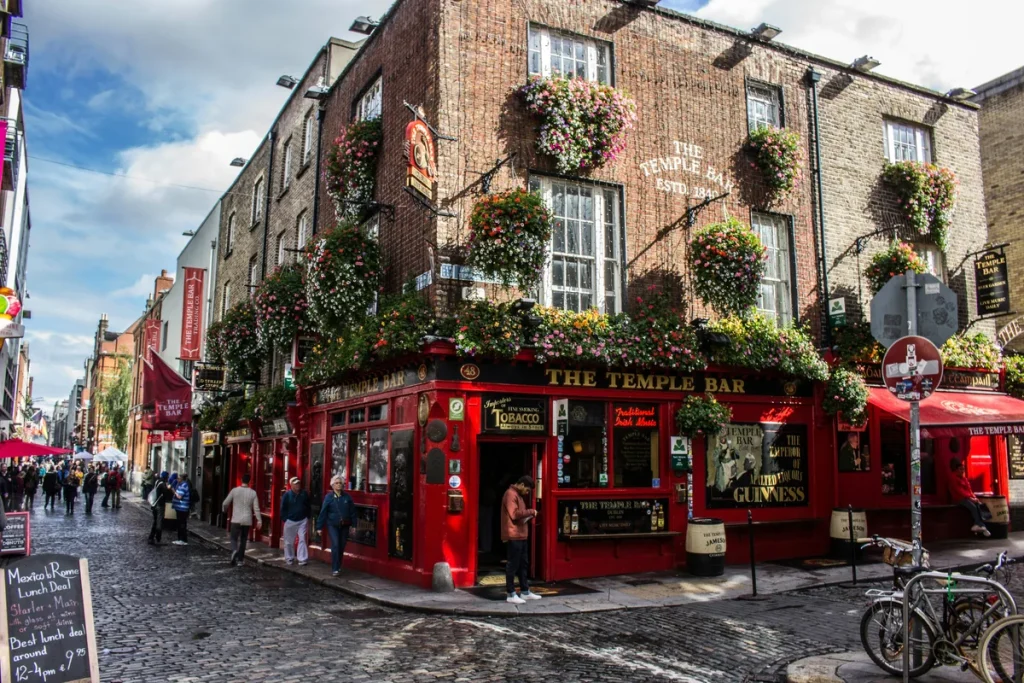
Temple Bar is the Dublin of the postcards, cobbled lanes, live music, galleries by day and song by night. It is wonderful to walk through and worth an evening of your trip, though the center of it can run late and loud. The easy solution is to base yourself a street or two back, along the river, where you keep the energy at your doorstep and the quiet in your room.
The The Morrison Dublin, Curio Collection by Hilton does exactly this, a stylish riverside hotel on the north bank of the Liffey, a short bridge-crossing from Temple Bar and Grafton Street, with the polish and the familiar comfort of the Hilton family behind it. The Morgan sits a step away in the heart of Temple Bar on Fleet Street, a sleek four-star for a woman who wants the music and the galleries at her door and does not mind a little evening sound.
Ballsbridge: Leafy, Refined, and Residential
South of the Grand Canal, Ballsbridge is Dublin’s embassy quarter, all broad avenues, mature trees, and handsome villas. It feels residential and settled, a ten-minute tram or taxi from the center, and it suits a woman who likes to return each evening to somewhere green and calm rather than the middle of the bustle.
The InterContinental Dublin anchors the neighborhood, a grand hotel set in its own gardens with a spa and a reputation for looking after guests beautifully. For a well-priced four-star in the same green quarter, the Clayton Hotel Ballsbridge sits across from the RDS on Merrion Road, a roomy, comfortable base a short walk from the DART. You can also browse more Ballsbridge hotels on Expedia if you want to weigh a few options in this leafier pocket.
Also Worth Considering: Portobello and the Grand Canal
If you like a neighborhood that feels local, the streets around Portobello and the Grand Canal reward it: brightly painted houses, independent cafes, and a towpath made for a morning walk. It is an easy stroll into the center and a relaxed, lived-in counterpoint to the busier heart of the city, a quiet favorite for a repeat visitor who already knows Dublin a little. Wherever you land, you can browse Dublin hotels on Expedia to compare dates and neighborhoods side by side.
Which Dublin Neighborhood Is Right for You?
For a first trip with everything on your doorstep, choose St. Stephen’s Green and Grafton Street. For Georgian calm, galleries, and painted doors, choose Merrion Square. For riverside energy within reach of the music, choose Temple Bar and the Liffey, a street back. For a green, residential quiet to come home to, choose Ballsbridge. And for a local, canal-side feel on a return visit, look to Portobello.
Is Dublin Safe for a Solo Woman Over 50?
Dublin is a welcoming, sociable city, and a solo woman over 50 moves through it with ease. The central neighborhoods above are well-lit and busy into the evening, the people are famously willing to stop and help, and the everyday good sense you carry anywhere serves you well here. Keep your bag zipped on the busiest stretches of Grafton Street and around the late-night bustle of Temple Bar, and the city will meet you with warmth and an easy conversation. The main Dublin solo travel guide goes deeper on this.
Practical Tips for Booking Your Dublin Stay
- Book the neighborhood, then the hotel. In a city this walkable, the street you wake up on shapes the trip more than the room does. Decide on the mood first.
- Ask for a quiet room when you book near Temple Bar or Grafton Street, away from the street and above the ground floor, and you keep the location without the late-night sound.
- Arrange your airport transfer in advance. A pre-booked airport transfer waiting with your name is a soft landing after a long flight, far nicer than waiting for a taxi.
- Get online the moment you land with an eSIM for staying connected abroad, so your maps and your messages work from the gate.
- Protect the trip before you go. It is worth having travel insurance for women over 50 in place before any trip, quietly covering the what-ifs so you can forget about them. If you want to think it through, here is what travel insurance for women over 50 should include.
- A lightweight case earns its keep on Dublin’s cobbles and tram platforms. A smooth-rolling hard-shell case makes the airport-to-hotel stretch effortless.
Frequently Asked Questions About Where to Stay in Dublin
Which neighborhood is best for a solo woman over 50 in Dublin?
St. Stephen’s Green and Grafton Street is the most reassuring base for a first trip: central, walkable, lively in the evening, and a short stroll from Trinity College and the main sights. Merrion Square is the quieter, more elegant alternative close by.
Where should I stay in Dublin for a first trip?
Stay around St. Stephen’s Green or Grafton Street. You will be able to walk to almost everything, find somewhere open for dinner alone, and get home easily on foot after an evening out.
Is Temple Bar a good area to stay in Dublin?
Temple Bar is wonderful to visit and worth an evening, but its center runs late and loud. Base yourself a street or two back, along the river near The Morrison, and you keep the atmosphere close while keeping your room calm.
Is Ballsbridge a good area to stay in Dublin?
Yes, if you prefer leafy, residential quiet. Ballsbridge is Dublin’s embassy quarter, handsome and green, about ten minutes from the center by tram or taxi, and a lovely base for a woman who likes to come home to calm.
How many nights do I need in Dublin?
Three nights let you see the heart of the city without rushing: Trinity College and the Book of Kells, a Georgian square or two, a day’s excursion to the coast or the Wicklow hills, and time simply to sit with a coffee and watch Dublin go by.
Where Is the Best Area to Stay in Dublin?
For most solo women over 50, the best area to stay in Dublin is St. Stephen’s Green and Grafton Street, central, walkable, and warm in the evenings, with Merrion Square a quieter, more elegant neighbor and Ballsbridge a leafy retreat for those who want calm at the end of the day. Choose the mood you want to wake up to, and the city makes the rest easy.
If you are still deciding on the where of the whole trip, there are sister guides to lean on: where to stay in Prague, Paris, Rome, Florence, London, Lisbon, Amsterdam, Venice, Vienna, Copenhagen, Barcelona, Seville, and Edinburgh. Or, if you’d like to roam a little wider, there is a whole library of destinations waiting from every corner of the world.
If you want to carry this further, there are two books. Wandersister: A Solo Woman’s Guide to Paris is a full guide to the city: the neighborhoods, the stays, the long lunches, and the itineraries that tie them together. The Wandersister Roadmap is the wider map: how to plan, how to find and vet the women you’d actually want to travel with, and, in its closing chapters, how some of them decide to stop parting at the airport and share a home abroad instead. That idea has a place of its own, A Home Abroad, the platform I built for exactly this.
When you are ready to plan this trip, and to swap notes with other women 50+ who have done it or are dreaming of it, come inside the Wandersister Circle, our private space for independent women who travel solo. It is free to step inside, whether you come for the travel knowledge, the conversation, or the possibility of connecting with women who see the world much as you do.