
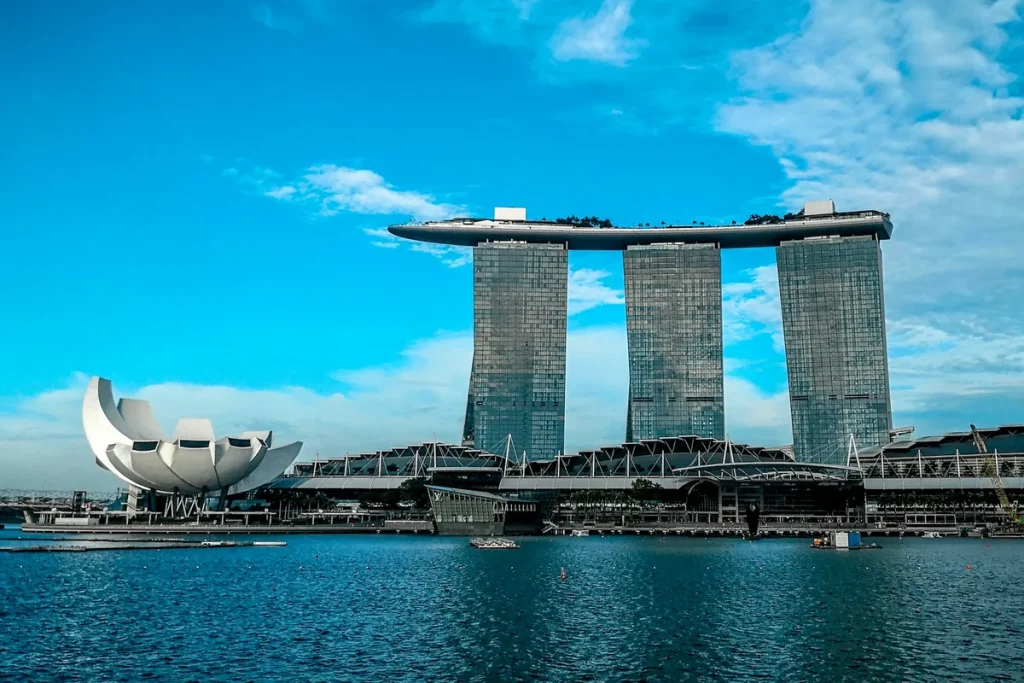
Singapore arrives all at once. You step out of the airport into air that is warm and green and faintly sweet, orchids in the terminal, rain somewhere over the water, a skyline of glass rising straight out of the tropics. It is Asia at its most beguiling and, quietly, its most welcoming: a city where everything unfamiliar comes to meet you halfway.
For a woman over 50 traveling solo, that is a rare kind of gift. You can follow a temple-lined lane through the morning, take the best meal of your week at a marble table set for one, and watch the towers come alight over the bay at night, and all of it feels as easy as it is beautiful. This is a guide to solo travel Singapore for the traveler who wants the color and depth of Asia at its most welcoming, which is why Singapore sits on our list of the safest countries for solo women over 50.
If you are mapping out a journey like this, our guide to solo travel for women over 50 is the place to begin.
Why Singapore Rewards the Solo Traveler Over 50
Singapore is a city-state, which means the whole country is one compact, connected place. You can cross it by train in under an hour, and the distance between a rainforest garden, a hawker lunch, and a rooftop view is often just a few stops. Nothing about a day here is hard to arrange.
It is also four cultures layered into one small island (Chinese, Malay, Indian, and Peranakan), so a single afternoon can take you from a Buddhist temple in Chinatown to a Hindu temple in Little India, with some of the best food of your life in between. For a solo traveler, that variety is a gift. There is always a next thing to see, and it is always close.
And the eating is a joy in itself. The hawker centres, those open-air halls full of food stalls, turn out some of the best food in the city for a few dollars a plate, and a marble-topped table in an old coffee shop, with a kopi and a plate of noodles in front of you, is one of its simplest pleasures.
The travel essentials every solo woman over 50 should have before she goes: packing, staying safe, money, eating alone, and where to base yourself. Add your details and it is yours, free.
No spam, ever.
Is Singapore Safe for Solo Female Travelers Over 50?
Yes. Singapore is consistently ranked among the safest cities in the world, and that reputation holds up for a solo female traveler over 50. Violent crime is rare, the streets are well lit and busy into the evening, and the train system runs safely late into the night.
The usual common sense still applies: keep an eye on your bag in a crowded hawker centre or on a packed train at rush hour, and stick to the lit, lively streets rather than empty side lanes very late. Beyond that, you will likely find that a solo female traveler over 50 moves through this city with almost no friction at all.
The Best Things to Do in Singapore
The pleasure of Singapore solo is how easily the big sights absorb a single traveler. You set your own pace, linger where you like, and move on when you are ready.
Start with Gardens by the Bay, the city’s signature green space on Marina Bay. The outdoor Supertree Grove is free to walk through, and the two cooled conservatories, the Cloud Forest with its indoor mountain and waterfall and the Flower Dome, are worth the ticket and perfect for a solo wander at your own speed. Come back after dark for the light show among the Supertrees.
Give a morning to the cultural quarters, all walkable and all a short train ride apart. Chinatown has its temples, its wet market, and the famous hawker stalls. Kampong Glam gathers around Arab Street’s textile shops and the cafés and murals of Haji Lane. And Little India is the most vivid of the three, loud and fragrant and wonderful to walk through with no plan at all.
For a cooler, quieter stretch, the Singapore Botanic Gardens are a UNESCO World Heritage Site and free to enter, with the National Orchid Garden tucked inside. The ArtScience Museum and the National Gallery give you air-conditioned hours with world-class art when the afternoon heat sets in.
Two experiences reward a little planning. The Singapore Night Safari is the world’s first nighttime zoo, and a tram ride through it is an easy, companionable evening for one. And a Singapore River evening cruise is the loveliest way to see the skyline light up, a bumboat down the water past Clarke Quay and the Marina Bay towers, with nothing to do but watch.
The Best Time to Visit Singapore
Singapore sits almost on the equator, so it is warm and humid every month of the year. Expect heat, bright afternoons, and the odd tropical downpour whatever the season. There is no bad time to come, only slightly drier ones.
February to April is the sweet spot: these are usually the driest, brightest months, with February often the driest of all. The mid-year stretch, roughly June to September, is also good, with lower humidity and longer sun, though you should expect short afternoon showers. The wettest weeks come with the monsoon from November into December, when the rain is heavier and more frequent. It is still very doable, so just pack a light umbrella.
If you enjoy a city with something on, late January or February often brings Chinese New Year, and September brings the lights and crowds of the Grand Prix.
Getting Around Singapore
This is the easy part. The MRT, Singapore’s clean, cheap, air-conditioned train network, connects almost every place in this guide, often in under twenty minutes, and the signs and announcements are all in English. Tap in with a contactless credit card or buy a stored-value card at any station, and you do not need to think about it much beyond that.
Taxis are metered and honest, and ride-hailing apps like Grab work exactly as you would expect. You will not need a car, and you would not want one, because parking is scarce and the trains are faster. From Changi Airport, the MRT reaches the city in about 40 minutes, or you can pre-book a private transfer with Welcome Pickups so a driver is waiting for you by name after a long flight.
Where to Stay in Singapore
Singapore is compact enough that any central neighborhood puts you minutes from everything by train. These four are all well placed, safe, and easy to come home to after a full day, arranged from a comfortable base up to a true splurge. Each links through to live rates, and if none is quite right you can always browse every Singapore hotel on Expedia.
In the museum-and-civic heart near City Hall, Carlton Hotel Singapore is a large, polished address a short walk from Bras Basah, the Padang, and the start of the cultural quarters, central to everything without being in the thick of the nightlife.
On the famous shopping belt, YOTEL Singapore Orchard Road is a sleek, modern base with a rooftop pool and sky garden, a smart choice if you like bright, efficient rooms and Orchard’s malls and cafés at the door.
Downtown in the business district by Tanjong Pagar, Oasia Hotel Downtown Singapore is a landmark in its own right, a slender tower wrapped in red mesh and climbing greenery, with leafy sky terraces and a rooftop infinity pool. It is one of the city’s best-reviewed addresses and an easy base a few train stops from the bay and Chinatown.
And if you would like to spoil yourself, this is the one: Raffles Singapore, the white colonial grande dame that opened in 1887, all teak verandas, tropical courtyards, and the bar where the Singapore Sling was poured first. It is a treat, and a memory you keep.
A 3-Day Itinerary in Singapore
Day 1, Marina Bay and the gardens. Ease in along the waterfront promenade, where the whole skyline curves around the water and the ArtScience Museum opens like a white flower at the edge. Spend the afternoon in the cooled conservatories at Gardens by the Bay, the Cloud Forest with its indoor mountain and mist and the Flower Dome beside it, then find a bench for the Supertree light show after dark. For a view to end the day, the rooftop bars around the bay are made for a long evening drink.
Day 2, the cultural quarters. Give the morning to Chinatown, its temples and lanes and the steam rising off the hawker stalls, and sit down to lunch at a marble table with a plate of something you have never tried. In the afternoon, cross to Kampong Glam for the textile shops of Arab Street and the cafés and murals of Haji Lane, then on to Little India, the most vivid stretch of the city, loud and fragrant and lovely to walk through with no plan at all. End with a cold drink somewhere on Haji Lane as the day cools.
Day 3, green and glittering. Start in the Botanic Gardens while the air is still fresh, with the National Orchid Garden tucked inside, then spend the hot middle of the day in a museum, the National Gallery or the ArtScience, where the hours pass easily in the cool. Save the evening for the water: a Singapore River cruise past Clarke Quay and the Marina Bay towers is the loveliest way to watch the skyline come alight, and a fine last night in the city.
Practical Tips for Solo Travel in Singapore
- Sort your travel insurance first. Before anything else is booked, arrange your cover, because medical care in Singapore is excellent but private and can be costly without it. This is the policy we recommend for travel insurance for women over 50, and here is our fuller guide to travel insurance for women over 50 if you want to compare.
- Stay connected from the moment you land. An Airalo eSIM gives you data the second your plane touches down, useful for maps, Grab, and messages home, with no hunting for a SIM card.
- Dress for heat and air-conditioning both. It is hot and humid outside and briskly cool inside the malls, museums, and trains, so light clothes with a wrap or light layer you can add indoors will serve you all day. A scarf also covers your shoulders for the temples.
- Carry a little cash for the hawker centres. Cards work almost everywhere, but a few stalls are cash-only, so keep some small notes for lunch.
- Travel light and roll with it. A good four-wheel case glides through Changi and the MRT. This is the Samsonite we travel with.
Solo Travel Singapore FAQ
Is Singapore a good destination for a solo woman over 50?
Wonderfully so. English is everywhere, the transport is flawless, the city is exceptionally safe, and the layering of Chinese, Malay, Indian, and Peranakan culture gives you a rich, varied trip with none of the friction that wears you down.
How many days do you need in Singapore?
Three full days cover the highlights comfortably. Four or five let you slow down, add a garden or a museum, and enjoy the food without rushing.
Where should I eat in Singapore?
The hawker centres are the heart of how the city eats: open-air halls with a hundred stalls, shared tables, and some of the best food in Asia for a few dollars a plate. Maxwell, Lau Pa Sat, and Newton are famous ones, and a kopi in an old coffee shop is a pleasure all its own.
Do I need to book attractions in advance?
A few, like the Night Safari or the Gardens by the Bay conservatories, are smoother with a ticket in hand, but much of the city, the neighborhoods, the temples, the Botanic Gardens, you can simply walk into.
Is Singapore Worth It for a Solo Female Traveler Over 50?
For a safe, rich, and effortless trip, Singapore is one of the best there is for a solo woman over 50. You get food worth flying for, a city where everything simply works, refined places to stay, and days that fall into place on their own, so your only job is to enjoy them. Go for four or five days, let the city carry you, and you will leave already thinking about when to come back.
If you are deciding where in Asia to go next, there are sister guides to lean on: Japan, Thailand, Vietnam, Bali, and Sri Lanka, with our wider Solo Travel Asia guide mapping the rest. Or, if you’d like to roam a little wider, there is a whole library of destinations waiting from every corner of the world.
If you want to carry this further, there are two books. Wandersister: A Solo Woman’s Guide to Paris is a full guide to the city: the neighborhoods, the stays, the long lunches, and the itineraries that tie them together. The Wandersister Roadmap is the wider map: how to plan, how to find and vet the women you’d actually want to travel with, and, in its closing chapters, how some of them decide to stop parting at the airport and share a home abroad instead. That idea has a place of its own, A Home Abroad, the platform I built for exactly this.
When you are ready to plan this trip, and to swap notes with other women 50+ who have done it or are dreaming of it, come inside the Wandersister Circle, our private space for independent women who travel solo. It is free to step inside, whether you come for the travel knowledge, the conversation, or the possibility of connecting with women who see the world much as you do.