
Paris rewards you for staying put. You could spend a week wandering the same handful of arrondissements and never run out of cafés, gardens, or small museums to fall for. But one of the quiet luxuries of this city is how easily it lets you leave for a day and be back by dinner.
From the right train station, a palace, a cathedral, or a painter’s garden is closer than a cross-town errand. You step onto a train with a coffee, watch the suburbs give way to wheat fields and poplars, and an hour later you are somewhere entirely new, with the whole day ahead of you and your hotel bed waiting that evening.
This is the part of France that first-time visitors often skip and seasoned travelers come back for. If you have given yourself more than three days in the capital, or you simply love the rhythm of a train journey, these are the day trips worth building a morning around. These are the seven we would send a good friend on, each chosen for how easily you reach it and what makes it worth the ticket. Every one suits a solo female traveler over 50 who wants a rich day out with no fuss. If you are newer to traveling alone, our complete guide to solo travel for women over 50 is a warm place to begin.
How Day Trips From Paris Actually Work
There are two ways to do this, and both are easy.
The first is to go by train and lead the day yourself. Paris has six main stations, each pointing toward a different corner of France, and most of the trips below leave from Gare Saint-Lazare, Gare Montparnasse, or Gare de l’Est. You can buy tickets at the station on the day, but for the fast TGV routes a seat reservation is required, so it is worth booking ahead. Omio is the easiest way to compare train times and reserve seats in one place, in English, before you leave home.
The second is to take a guided tour that handles the driving. For the trips that sit too far for a comfortable train day, Mont-Saint-Michel and the Loire Valley castles, a small-group tour is the easy choice. Someone else navigates the back roads, you watch the countryside roll by, and you arrive with a guide who knows which staircase to climb first.
A note before you go: book your headline sight in advance wherever timed entry is offered. Versailles, Giverny, and the Champagne cellars all sell timed tickets, and in a busy season the on-the-day line can swallow an hour you would rather spend inside.
The shortlist, drawn from the world's leading safety research, with why each one is easy to move through on your own. Add your details and it's yours, free.
No spam, ever.
Versailles: The Palace That Sets the Standard
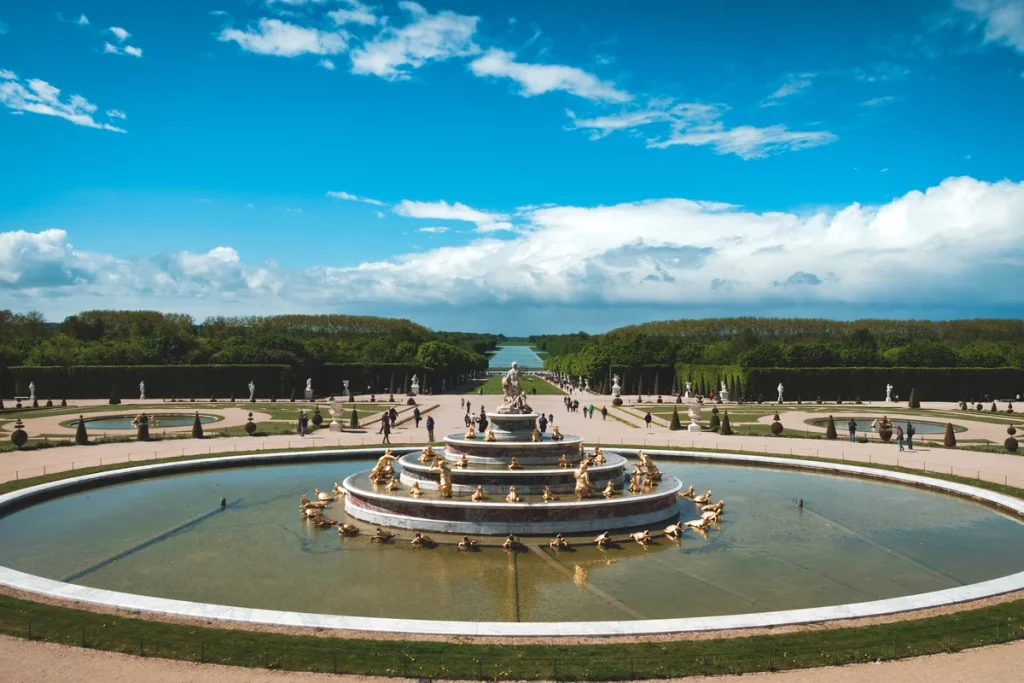
If you do only one day trip from Paris, make it Versailles. It is the closest of the great escapes and still the most astonishing, a palace so vast and so gilded that photographs never quite prepare you for standing in the Hall of Mirrors as the light moves across it.
Give the morning to the château itself. Start in the State Apartments while they are quietest, then the Hall of Mirrors, then the King’s and Queen’s chambers. By late morning you will be ready for air, and that is the pleasure of Versailles: the gardens are as much the point as the palace. Le Nôtre’s parterres, the Grand Canal, the long green allées that seem to run to the horizon. Pack a picnic or stop at a garden café, then spend the afternoon walking out to the Grand and Petit Trianon and Marie-Antoinette’s hamlet, the toy farm where she kept her dairy.
Getting there: the RER C line runs from central Paris to Versailles Château–Rive Gauche in about 40 to 45 minutes, a short walk from the gates. Train works on the Paris region are frequent, so check your route on the day, and if the RER C is disrupted, the Transilien N line from Gare Montparnasse reaches Versailles Chantiers instead. The palace is closed on Mondays, so plan for any other day. A guided skip-the-line Versailles tour is the easiest way to walk straight in and have the rooms explained as you go.
Giverny: Monet’s Garden, and a Very Good Year to See It
An hour northwest of Paris, the painter Claude Monet spent the last half of his life building the garden that became his greatest subject. Giverny is not a grand estate. It is a pink house with green shutters, a flower garden that spills over its paths, and the famous water garden beyond, with its willow, its Japanese bridge, and the pond of water lilies you have seen on a hundred gallery walls.
Seeing it in person rearranges how you remember the paintings. 2026 marks one hundred years since Monet’s death, so expect the gardens to be busier than usual and all the more cared for. The flowers peak from late April into June, but the garden is lovely through the autumn too.
Go in the morning if you can, and be at the gate near opening so you have the water garden before the coaches arrive. Afterward, the village itself is worth an hour: the little lanes, the church where Monet is buried, a long lunch at one of the auberges. This is a wonderful day for a solo female traveler over 50 who wants beauty without a single logistical headache.
Getting there: take the train from Gare Saint-Lazare to Vernon, about 45 to 50 minutes, then the shuttle bus that meets the trains for the short hop to Giverny. The gardens are open from the start of April to the start of November, and timed tickets booked online let you skip the ticket line. If you would rather not think about shuttles at all, a half-day Giverny tour collects you in Paris and includes your entry.
Chartres: The Cathedral and Its Famous Blue
A little over an hour from Paris stands one of the most complete Gothic cathedrals in the world, and the reason to come is the light. Chartres kept nearly all its medieval stained glass, some 170 windows that have colored the air inside for eight hundred years. The deep “Chartres blue” is a color you will not quite believe until you are standing under it on a bright day, watching it pool across the stone floor.
This is an easy, satisfying day. The cathedral is the heart of it, and a couple of hours inside is time well spent. Then the old town unfolds below it, a tangle of cobbled lanes and the River Eure, with enough small restaurants for a proper French lunch. The Stained Glass Centre near the cathedral is a quiet, rewarding stop if the windows leave you wanting to understand how they were made.
Getting there: direct TER trains run roughly every hour from Gare Montparnasse and take a little over an hour. Entry to the cathedral itself is free, with a modest fee for the crypt and towers. Parts of the interior may be under restoration through 2026, so a window or two could be screened. From April through the autumn the town stages its evening illuminations, when the cathedral and other buildings are lit after dusk, which is a reason to linger into the early evening if the season is right.
Reims: Coronation Cathedral and the Chalk Cellars
Forty-five minutes east of Paris by fast train, Reims is where the kings of France were crowned for a thousand years, and its cathedral is the equal of Notre-Dame. Notre-Dame de Reims is a soaring, sculpture-covered Gothic masterpiece, and inside, alongside the medieval glass, are luminous windows designed by Marc Chagall in the twentieth century. Next door, the Palais du Tau holds the treasures of the coronations.
Reims is also the capital of the Champagne region, and part of what makes it remarkable is underground. Beneath the city run miles of chalk cellars called crayères, quarried by the Romans and now used by the great Champagne houses to age their bottles in the cool and the dark. A cellar visit here is really a walk through two thousand years of history, down into caverns of white stone. The houses most people know, including Taittinger, Veuve Clicquot, and Ruinart, sit within reach of the center, and many offer guided heritage tours of their cellars.
Spend the morning with the cathedral and the Palais du Tau, have lunch in the center, and give the afternoon to a cellar tour booked in advance.
Getting there: the direct TGV from Gare de l’Est reaches Reims Centre in about 45 minutes, and the station is a ten-minute walk from the cathedral. The TGV needs a seat reservation and there are only a handful of departures a day, so book ahead rather than turning up. A guided Reims cathedral and cellars day tour takes care of the timings if you would rather not assemble the day yourself.
Strasbourg: France With a German Accent
Less than two hours east of Paris, right on the German border, Strasbourg is one of the most beautiful cities in France and a world away from the capital in feeling. Its old town, the Grande Île, is a UNESCO-listed island ringed by the River Ill, a storybook tangle of half-timbered houses, cobbled lanes, and canals that is small enough to cross on foot and rich enough to fill a day with ease.
The cathedral is the landmark: a soaring pink-sandstone masterpiece with an astronomical clock that draws a crowd each day when its figures begin to move. From there the city unfolds in small pleasures. Petite France, the old tanners’ quarter, is the loveliest corner, where timbered houses lean over the water and little bridges cross the canals. A short boat tour on the Ill shows you the island from a different angle. And because this is Alsace, the food carries a German warmth the rest of France does not: tarte flambée, choucroute, and the buttery little Christmas cookies called bredele.
Spend the morning with the cathedral and the astronomical clock, wander Petite France and the canals before lunch, and give the afternoon to the squares and craft shops of the old town. If you come between late November and Christmas Eve, Strasbourg transforms into the oldest and most famous Christmas market in France, and our full guide to the Strasbourg Christmas market for women over 50 covers that season in detail.
Getting there: the direct TGV from Gare de l’Est reaches Strasbourg in about one hour and 45 minutes, with trains roughly hourly through the day, and the station is a ten-minute walk from the old town. A seat reservation is required, so book ahead; you can compare times and reserve with Omio.
The Loire Valley: A Day Among the Châteaux
The Loire Valley is where French royalty and nobility built their fantasies in stone, a long green river valley strung with more than a dozen great castles. You cannot see them all in a day, but you can see the two finest, and a guided tour makes an easy day of what would otherwise be a long drive.
Chambord is the giant: the largest château in the valley, a forest of towers and chimneys around a double-helix staircase so clever it is linked to Leonardo da Vinci, who spent his final years nearby. Climb to the rooftop terraces and the whole estate opens beneath you. Chenonceau is the opposite and just as unforgettable, an elegant château that arches right across the River Cher on a series of stone bridges. It is known as the Ladies’ Castle for the women who built, saved, and shaped it over the centuries, which gives the visit a story worth following room to room.
A small-group tour is the loveliest way to do this. You are collected in Paris, driven through the countryside, and walked through each castle with a guide, often with a village lunch stop in between.
Getting there: the valley sits around three hours by road, so a guided Loire Valley castles day trip covering Chambord and Chenonceau is the way to go. Small-group minivan tours are more comfortable and more personal than the big coaches, if the price suits you.
Mont-Saint-Michel: The Grand Finale
Some sights earn a long day, and Mont-Saint-Michel is the one worth crossing France for. A medieval abbey crowning a rocky island in a vast tidal bay on the Normandy coast, it rises out of the sand and the sea like something imagined rather than built. The village climbs the rock in a single winding street, the ramparts look out over the bay, and the abbey sits at the summit, reached by a climb that is part of the pilgrimage it has always been.
It is far, around four hours each way, so this is a full day of twelve to fourteen hours and worth every minute if the Mount is a dream of yours. A guided tour is by far the easiest way: you are driven door to door, you keep your energy for the island itself, and a guide helps you make sense of what you are seeing. Aim for a weekday outside the school holidays, when the Mount is at its calmest, and give yourself a good three hours there to walk the street, the ramparts, and the abbey at the top.
Getting there: a full-day guided Mont-Saint-Michel tour from Paris is the least stressful choice and removes the long drive entirely. If you prefer the train, a direct service from Gare Montparnasse reaches Pontorson in under four hours on weekends year-round and daily from April to October, with a shuttle on to the Mount, though the tour makes for a smoother day.
A Few More Easy Escapes
If you have extra days and want shorter, simpler trips, three more sit within easy reach. Fontainebleau, about 40 minutes by train from Gare de Lyon, is a sumptuous royal château with a fraction of the Versailles crowds. Chantilly, 25 minutes from Gare du Nord, pairs a storybook château with one of the great art collections in France. And Auvers-sur-Oise, north of the city, is where Van Gogh spent his last months and painted furiously, a small village where you can still stand where he set his easel.
Where to Base Yourself in Paris
Every one of these trips is easier when your hotel sits near the right station or on a direct Métro line to it. If you are still choosing where to stay, our full guide to the best Paris neighborhoods for women over 50 walks through the areas we recommend and why. And if you are shaping the days you spend in the city itself, our 3-day Paris itinerary lays out an easy, well-paced plan you can slot these day trips around.
Is It Safe to Take Day Trips From Paris Alone?
Yes. France is a straightforward, welcoming country for a solo female traveler over 50, and day trips are some of the easiest travel you can do. The trains are clean, punctual, and well used by ordinary travelers, the towns on this list are visited by tourists year-round, and nothing here asks anything unusual of you.
A few simple habits make the day smoother. Book your return train before you leave so you are not improvising at the end of a long afternoon, and screenshot the times in case your signal drops. Keep your bag zipped and in front of you in busy stations, as you would anywhere. Carry a little cash for village cafés and shuttle buses that may not take cards. And tell your hotel where you are headed, which is simply good practice on any solo day away.
Staying connected is worth sorting before you travel. A travel eSIM gives you maps, train updates, and translation the moment you land, with no roaming bills and no hunting for a SIM card. For peace of mind on the bigger trips, travel insurance through VisitorsCoverage means a missed connection or a cancelled tour is an inconvenience rather than a loss.
Frequently Asked Questions About Day Trips From Paris
What is the best day trip from Paris?
For most first-time visitors, Versailles. It is the closest, the easiest to reach, and the most spectacular, and you can be there in under an hour. If you love gardens and painting, Giverny is the one that stays with people. If you want pure drama and do not mind a long day, Mont-Saint-Michel is unmatched.
Can you do Versailles and Giverny in one day?
Some tours combine them, but it makes for a rushed day and both deserve better. Give each its own morning. If your time is tight, choose by mood: the grandeur of the palace, or the intimacy of the garden.
Do I need a guided tour, or can I take the train?
It depends on the distance. Versailles, Giverny, Chartres, and Reims are easy, pleasant train trips you can lead yourself. The Loire Valley and Mont-Saint-Michel sit too far for a comfortable train day, so a guided tour that handles the driving is the better choice there.
How far ahead should I book?
Reserve TGV trains, such as the one to Reims, as early as you can, since seats are limited. Book timed entry for Versailles and Giverny a few days ahead in high season. Guided tours to the Loire and Mont-Saint-Michel can sell out in summer, so a week or two ahead is wise.
When is the best time of year for day trips from Paris?
Late spring and early autumn are ideal: the gardens are at their best, the days are long, and the summer crowds have thinned. Giverny closes for the winter, roughly November to April, so plan that one for the warmer months. The cathedrals, palaces, and castles are rewarding year-round.
You do not have to choose Paris or the rest of France. From a comfortable base in the city, the whole country opens up a train ride at a time, and some of your best memories may come from the mornings you spent leaving it. If you want the city days to go with these escapes, my Wandersister book, The Solo Woman’s Guide to Paris, maps out the city neighborhood by neighborhood.
When you are ready to plan it, and to swap notes with other women 50+ who love exploring France as much as you do, come inside the Wandersister Circle, our private space for independent women who travel solo. It is free to step inside, whether you come for the travel knowledge, the conversation, or the possibility of connecting with women who see the world much as you do.