
There is a particular quality of light along the Côte d’Azur that photographs never quite capture. It arrives somewhere around late afternoon, golden, unhurried, settling over pastel facades and cobalt water in a way that makes even a simple glass of rosé on a harbor terrace feel like an event worth remembering.
For the woman over fifty, the French Riviera solo travel offers something genuinely rare: a string of towns sophisticated enough to feel special, connected well enough that a car is never necessary, and relaxed enough that a woman traveling alone never feels conspicuous. From Nice to Saint-Tropez, here is why this stretch of coastline deserves a place near the top of your list.
A Coast Built for Trains, Not Cars
One of the quiet advantages of the Côte d’Azur is how little logistical planning it actually demands. The regional TER train line runs along the coast from Menton through Nice, Antibes, Cannes, and Saint-Raphaël, making the entire Riviera accessible without ever needing to rent a car or navigate unfamiliar roads alone. Book your train tickets along the coast ahead on Omio.
For Saint-Tropez specifically, which sits slightly off the main rail line, the most elegant solution is also the most enjoyable one: the ferry. Boats run regularly from Nice, Cannes, and Saint-Raphaël directly into the Saint-Tropez harbor, turning what could be a logistical inconvenience into one of the loveliest parts of the entire trip, arriving by water, watching the town’s pastel buildings grow larger as the boat approaches the port.
This combination of train and ferry means a woman traveling solo can base herself in one town and explore the entire coast with genuine ease, no driving required.
Nice, Elegant, Walkable, and the Perfect Base
Nice makes an excellent anchor for a Côte d’Azur trip. The Promenade des Anglais, stretching along the curve of the bay, is made for unhurried morning walks, and Nice’s Old Town, all narrow ochre streets and busy market stalls, rewards the kind of slow wandering that defines the Wandersister approach to travel.
The Cours Saleya market runs every morning except Monday, offering flowers, produce, and Provençal specialties in a setting that feels genuinely local rather than staged. A morning there, followed by a coffee at one of the surrounding café terraces, is one of the simplest and finest ways to begin a day in Nice.
Nice is also exceptionally well connected, its airport, train station, and the coastal TER line make it the natural starting and ending point for exploring the rest of the Riviera.
Cannes, Sophistication Without the Intimidation
Cannes carries a reputation shaped almost entirely by its film festival, but outside those two weeks in May, it reveals itself as something considerably warmer and more approachable, a kind of Paris-by-the-sea, with the elegance of a grand boulevard city compressed onto a stretch of Mediterranean coastline.
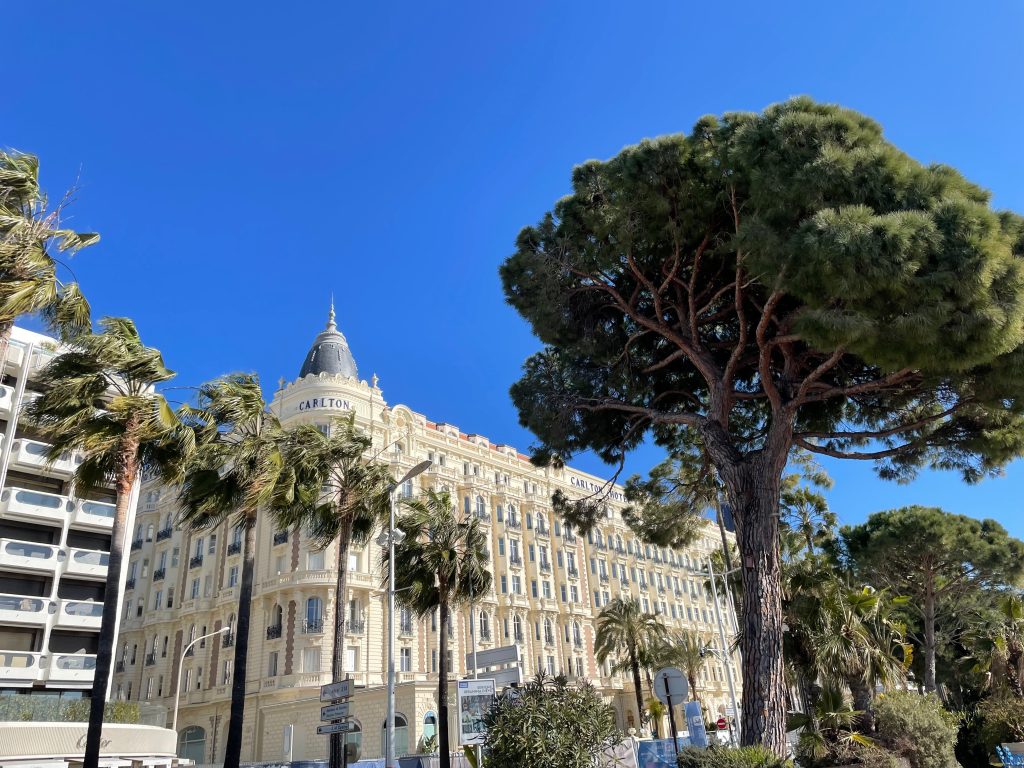
La Croisette, the town’s famous seafront promenade, is genuinely lovely for a long solo walk, palm-lined, dotted with grand hotels, opening onto beach clubs and the calm blue of the bay. But the real charm of Cannes lies just behind it, in Le Suquet, the old town climbing the hill above the harbor. Its narrow streets, small squares, and panoramic viewpoint over the bay offer a quieter, more textured counterpoint to the polish of La Croisette.
Cannes’ covered market, the Marché Forville, is one of the finest on the coast, a proper working market rather than a tourist attraction, ideal for assembling a simple lunch of local cheese, olives, and fruit to enjoy on a bench along the water.
For a woman traveling alone, Cannes offers genuine sophistication, good restaurants, elegant boutiques, a real sense of occasion, without ever feeling unwelcoming or difficult to navigate. It is, in the best sense, a small city that behaves like a grand one.
Wandersister Tip
Take the ferry from Cannes to the Îles de Lérins for an afternoon. Île Sainte-Marguerite, just fifteen minutes offshore, offers pine forests, a small fort, and quiet coastal paths, a genuinely peaceful escape from the more polished energy of the mainland, and an easy half-day trip requiring no planning beyond a ferry ticket, a calm difficult to find elsewhere in Europe.
Saint-Tropez, Arriving by Water
Saint-Tropez’s reputation for glamour and excess can feel intimidating from a distance, yachts, celebrity sightings, prices that seem designed to discourage anyone without a superyacht moored nearby. The reality, particularly outside of peak July and August, and particularly when arriving by ferry rather than by road, is considerably gentler.
The old port, with its pastel-colored buildings and small fishing boats moored alongside considerably larger vessels, is genuinely lovely to wander in the morning before the day’s crowds arrive. The old town’s narrow streets, lined with boutiques and quiet squares, reward aimless exploration in a way the marina itself does not.
A morning coffee at a harbor-facing café, watching the town wake up around the boats, is one of the simplest and finest ways to experience Saint-Tropez, made even better by knowing your return ferry is waiting whenever you’re ready, no drive required.
Wandersister Tip
Visit in late September or early October. The crowds and prices of high summer have receded, the ferries still run a full schedule, and the town reveals a considerably calmer, more authentic version of itself.
Two easy days out on your own: a day along the corniche to Èze and Monaco, and a guided walk through Vieux Nice to find its hidden corners.
Where to Stay for Your French Riviera Solo Travel
Basing yourself in Nice for the majority of your trip is the most practical approach, its transport connections make day trips to Cannes, Antibes, or Saint-Tropez entirely straightforward, and its Old Town offers genuine character within a compact, walkable footprint.
For a slightly different rhythm, consider splitting your stay between Nice and Cannes, two or three nights in each gives you a proper sense of both towns’ distinct personalities, and the train between them takes under 40 minutes.
A few stays we love along the coast: the belle-époque Hotel Le Negresco in Nice, the Hôtel Martinez on the Cannes seafront, and the legendary Grand-Hôtel du Cap-Ferrat on its private peninsula.
Fly into Nice (NCE), the Riviera’s gateway. From the airport, a pre-booked private airport transfer takes you straight to your hotel.
Practical Tips for the Solo Female Traveler 50+
The Côte d’Azur is considered very safe for solo women travelers, with the usual sensible precautions around bag security in crowded market and beach settings. English is widely spoken in the more touristed towns along this stretch of coast, and the regional train and ferry network is reliable, frequent, and simple to navigate even without French.
The larger practical consideration is seasonal: July and August bring significant crowds and inflated prices, while May, June, September, and October offer the same golden light and warm Mediterranean weather with a noticeably calmer, more local atmosphere, and considerably easier ferry bookings to Saint-Tropez.
For the woman seeking genuine elegance, effortless logistics, and a coastline that rewards slow exploration by train and by water rather than by car, the Côte d’Azur offers something difficult to find elsewhere in Europe.
Planning the rest of your trip? See our guides to Paris solo travel and the best European cities for solo women over 50, and the bigger picture in solo travel for women over 50. And sort your travel insurance for women over 50 before you go.
When you’re ready to plan it, and to swap notes with other women 50+ who’ve done it or are dreaming of it, come inside the Wandersister Circle, our private space for independent women who travel solo. It’s free to step inside, and the solo female traveler over 50 will find good company waiting.