
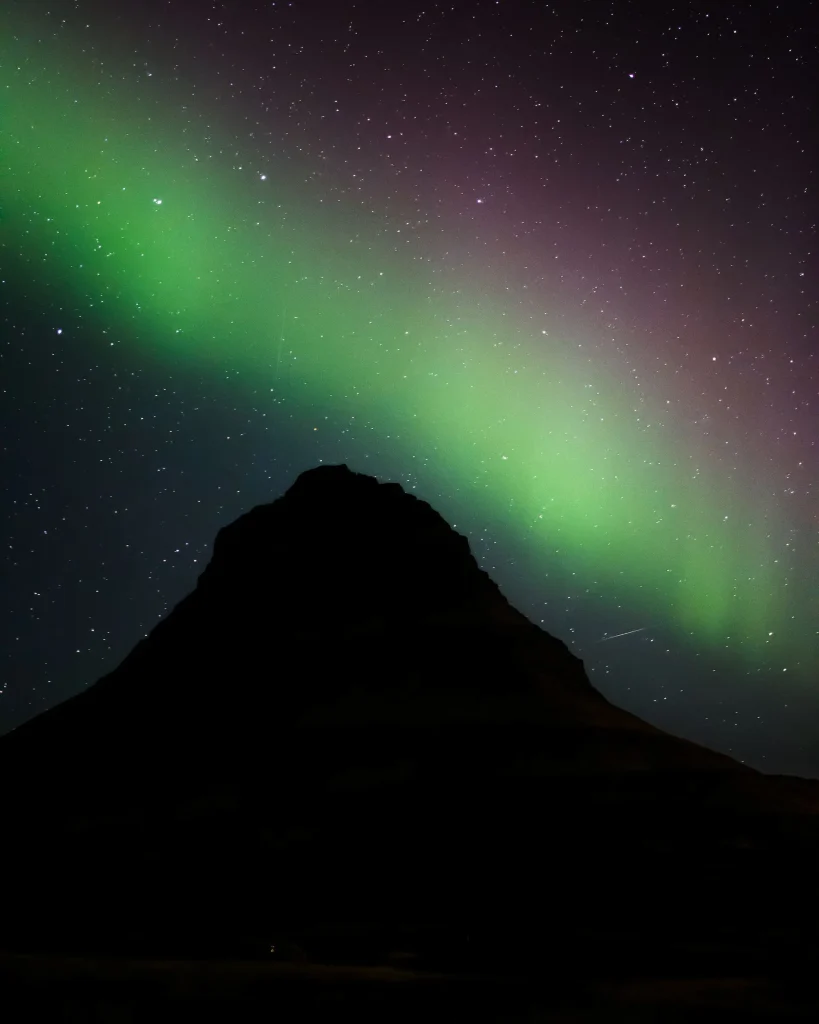
There are a few sights that rearrange something inside you, and the aurora borealis is one of them — which is why seeing the Northern Lights in Iceland over 50 belongs near the top of any list. Picture a silent ribbon of green light unrolling across a black Arctic sky, shifting and folding while you stand there with your breath held: one of the most achievable bucket‑list wonders there is, with no mountaineering and no danger, just a warm coat, a dark sky, and a little patience.
And there has rarely been a better time to go. The sun is at the peak of its 11-year cycle right now, which means 2026 brings the strongest aurora activity in over a decade — brighter, more frequent displays that won’t come around again for years. If seeing the Northern Lights in Iceland over 50 has been sitting quietly on your someday list, this is the winter to move it to the top.
When Is the Best Time to See the Northern Lights in Iceland?
The aurora is only visible when the skies are properly dark, which in Iceland means roughly late September through early April. Summer’s midnight sun makes them impossible, so this is firmly a cool-season trip.
The peak months are October through March, when the nights are longest and darkest. Within that, two windows are especially kind: late September into October and February into early March — both pair reasonable darkness with slightly better weather odds and the geomagnetic lift that comes around the equinoxes. February is a perennial favorite for its long, clear, dark nights. Wherever you land in the season, the lights are most active between about 10 p.m. and 2 a.m.
Where to See the Aurora
The single most important ingredient is darkness, so the further you get from city lights, the better. The classic dark-sky spots include Þingvellir National Park, the Snæfellsnes Peninsula, and the sublime Jökulsárlón Glacier Lagoon, where the lights can mirror in the water among the icebergs. That said, during a strong 2026 display you may well catch them from the edge of Reykjavík itself — a lucky bonus, though rural darkness is always the surer bet.
Should You Take a Tour or Drive Yourself?
For a woman traveling solo — and especially over 50 — a guided Northern Lights tour from Reykjavík is the easy, sociable, and smart choice. A small-group minibus with an aurora guide does the hard part for you: they track the cloud and solar forecasts in real time and drive to wherever the sky is clearest that night, which dramatically improves your odds. Most companies will even take you out again for free if the first night is a wash. It’s warm, safe, and you meet fellow travelers rather than squinting at a forecast alone in a rental car. A Northern Lights tour from Reykjavík is the one to book.
Self-driving to hunt the aurora is possible and gives you total freedom, but it means winter roads in the dark, ideally in a 4×4 — best left to those who are genuinely confident on ice. For most, the tour is the joy without the white knuckles. (For the bigger picture on getting around, see our main Iceland solo travel guide.)
How to Give Yourself the Best Chance
The aurora is a natural phenomenon, not a scheduled show, so a little strategy goes a long way:
- Stay at least 5–7 nights. More nights, more chances — a two-night dash is a gamble, but across a week your odds in peak season are genuinely good.
- Watch two forecasts. Check vedur.is for cloud cover (you want less than half the sky clouded) and an aurora-activity forecast for solar strength. Clear sky matters even more than strong activity — cloud is the number-one reason people miss the lights.
- Be nocturnal and patient. Plan for late nights, keep an eye out between 10 p.m. and 2 a.m., and don’t give up after twenty minutes; displays come and go.
- Base yourself well. A comfortable, central boutique hotels in central Reykjavík lets you warm up between tours and sleep in the next morning.
What the Northern Lights Are Really Like
It helps to arrive with the right expectations. On a quiet night the aurora can look like a pale grey-green smudge to the naked eye — and then your camera reveals the vivid color the sensor picks up that your eyes can’t. On a strong night, though, there’s no mistaking it: curtains of green and yellow rippling overhead, sometimes edged with pink or violet, and — rarest of all, but more common in Iceland than almost anywhere — a wash of deep red. No two nights are the same, and that unpredictability is part of the magic.
How to Photograph the Northern Lights
You don’t need professional gear. Modern phones with a night mode capture the aurora surprisingly well — prop the phone on something steady (a small tripod is ideal), use the longest exposure it offers, and keep still. If you bring a camera, a tripod and a long exposure (a few seconds, wide aperture) are the whole secret, and most guided tours will happily help you set it up. One tip: take a few shots, then put the phone down and simply watch. The memory matters more than the photo.
What to Wear and Bring
Aurora hunting means standing still, outdoors, late at night, in the cold — so warmth is everything. Layer properly: thermal base layers, a warm mid-layer, and a windproof, waterproof coat; add a hat, gloves, thick socks, and sturdy boots. Hand and foot warmers are small luxuries worth their weight, and a thermos of something hot is pure joy at midnight. Our solo female traveler’s packing list for Europe covers the layering essentials; just weight it toward winter. And because Icelandic weather turns on a coin, travel insurance for women over 50 is a non-negotiable before you go.
Is Seeing the Northern Lights in Iceland Over 50 Realistic?
More than realistic — it may be the ideal age to do it. You have the patience the aurora rewards, the means to travel in the comfortable, warm way that makes a winter trip a pleasure rather than an ordeal, and Iceland is the safest country on earth for a woman on her own. There’s no physical demand beyond standing in the cold and looking up. Book a week in peak season, base yourself in Reykjavík, take a guided tour or two, warm up in a lagoon by day, and let the sky do the rest.
Make It a Whole Trip
The lights are the headline, but the days are a gift too. Soak in the famous Blue Lagoon admission & transfer on your way in from the airport, spend a day on the Golden Circle or the South Coast, and wander Reykjavík’s cafés between adventures. For the full picture — where to stay, what to do, what it costs, and how to get around — start with our complete Iceland solo travel guide, and let this be the trip you finally stop dreaming about and start planning.
When you’re ready — and to find other women 50+ who’ve chased the aurora or are about to — come inside the Wandersister Circle, our private space for independent women who travel solo. It’s free to step inside.