
Rome is a city you could never finish. There is always one more piazza, one more church with a Caravaggio hiding in a side chapel, one more plate of cacio e pepe worth crossing town for. And yet some of the finest days of a Roman trip are the ones you spend leaving it, because Rome sits at the center of a country that opens up in every direction by train.
From the right station, an ancient city frozen in ash, a hilltop town above the Umbrian hills, a garden of a thousand fountains, or the Renaissance itself is an hour or two away. You board a fast train with a coffee, watch the campagna roll past the window, and step off somewhere entirely new with the whole day ahead of you and your Roman bed waiting that night.
If you have given yourself more than three or four days in the capital, these are the escapes worth building a morning around. These are the seven we would send a good friend on, each chosen for how easily you reach it and what makes it worth the day. Every one suits a solo female traveler over 50 who wants a rich day out with no fuss. If you are newer to traveling alone, our complete guide to solo travel for women over 50 is a warm place to begin.
How Day Trips From Rome Actually Work
There are two ways to do this, and both are easy.
The first is to go by train and lead the day yourself. Most of these trips leave from Roma Termini, the main station, with a couple from Roma Tiburtina. Italy’s high-speed trains, Frecce and Italo, are fast, comfortable, and reach Florence or Naples in well under two hours, while the slower regional trains serve the closer towns for only a few euros. For the high-speed routes a seat reservation is included with your ticket, so it is worth booking ahead. Omio lets you compare high-speed and regional trains and reserve a seat in one place, in English, before you leave home.
The second is to take a guided tour that handles the logistics. For the longer trips, Pompeii and the Amalfi Coast especially, a tour that bundles the train or the driving, the entries, and a guide turns a complicated day into a simple one.
A note before you go: book your headline sight and your fast train in advance. The Uffizi in Florence, Pompeii, and the Villa d’Este all reward a ticket bought ahead, and high-speed seats rise in price as the train fills.
The shortlist, drawn from the world's leading safety research, with why each one is easy to move through on your own. Add your details and it's yours, free.
No spam, ever.
Ostia Antica: Rome’s Ancient Port, Half an Hour Away
Everyone knows Pompeii. Far fewer know that Rome has its own complete ancient city barely half an hour from the center, and that you can have it almost to yourself. Ostia Antica was Rome’s great seaport, a working town of warehouses, apartment blocks, baths, and taverns, and because the sea retreated and left it behind, it survived remarkably intact.
Walking its grassy main street, the Decumanus Maximus, you pass the mosaics of the old merchant offices, climb into a well-preserved theater, and step inside houses where the frescoes still cling to the walls. It is the same pleasure as Pompeii, a whole Roman world to wander, without the long journey or the crowds.
This is the easiest day on the list. Give it a morning and a picnic or a long lunch at the little town of Ostia Antica beside the ruins, and you are back in Rome by mid-afternoon.
Getting there: take the train from Roma Porta San Paolo station, next to the Piramide Metro stop, direct to Ostia Antica in about 30 minutes. It is covered by a standard Metro ticket, which makes it one of the best-value days you can have near Rome.
Tivoli: A Hillside of Fountains and an Emperor’s Villa
An hour east of Rome, the hill town of Tivoli holds two of the most beautiful places in the whole region, and both are UNESCO World Heritage Sites. The Villa d’Este is a Renaissance pleasure garden built straight down a steep hillside, a cascade of terraces, grottoes, and some five hundred fountains fed entirely by gravity, with the famous Avenue of a Hundred Fountains running the width of the garden. On a warm day, with the water everywhere and the valley spread out below, it is pure enchantment.
A short distance away lies Hadrian’s Villa, the vast country estate the emperor Hadrian built for himself in the second century, a small city of pools, baths, libraries, and pavilions he modeled on the wonders he had seen across his empire. Together they make a rich, rewarding day: the emperor’s ruins in the morning, the Renaissance gardens in the afternoon.
Getting there: regional trains run from Roma Tiburtina to Tivoli in a little over an hour, roughly hourly, for a few euros, and a local bus connects the station with the gardens and with Hadrian’s Villa a few kilometers away. The Villa d’Este is closed on Mondays, so plan another day. If you would rather not coordinate the local buses between the two sites, a guided Tivoli day trip from Rome takes you door to door and walks you through both.
Orvieto: A Golden Cathedral on a Cliff
An hour north, Orvieto rises on a great plateau of volcanic rock, a honey-colored town that has crowned its cliff since Etruscan times. The reason everyone comes is the Duomo, and it earns the trip on its own: a Gothic cathedral whose facade is a shimmer of golden mosaics and carved stone, one of the high points of Italian art, and inside, the Chapel of San Brizio with Luca Signorelli’s thunderous Last Judgment, frescoes that Michelangelo himself came to study.
Beyond the cathedral, Orvieto rewards a slow wander. Descend St. Patrick’s Well, a Renaissance feat of engineering with a double-helix staircase spiraling fifty meters into the rock, or take the short underground tour through the Etruscan caves and tunnels beneath the streets. The town itself, all stone lanes and quiet corners, is made for a long lunch and an afternoon with no particular plan.
Getting there: direct trains run from Roma Termini in about an hour to an hour and a quarter. From Orvieto’s station, a little funicular carries you up the cliff to the old town in a few minutes, a small pleasure in itself with the view opening as you rise. If you would like the day arranged for you, a guided Orvieto day trip from Rome includes the train and the cathedral.
Florence: The Renaissance in a Day
It still surprises people that Florence, the cradle of the Renaissance, is an easy day trip from Rome. The high-speed train makes the run in about an hour and a half, often less, which leaves you a full, rich day in one of the most beautiful cities in the world.
A day is not Florence entire, but it is plenty for its greatest things. Stand before Michelangelo’s David at the Accademia, booked ahead so you walk past the line. Lose an hour or three in the Uffizi among Botticelli and Leonardo. Climb inside Brunelleschi’s dome, or simply stand in the Piazza del Duomo and take in that impossible marble cathedral. Cross the Ponte Vecchio with its goldsmiths’ shops, and finish with the view over the whole city from the Piazzale Michelangelo as the light turns gold. If Florence pulls you back for longer, our Florence solo travel guide maps out a fuller visit.
Getting there: frequent high-speed Frecce and Italo trains leave Roma Termini for Florence throughout the day, about an hour and a half each way, and the station sits a short walk from the Duomo. Book the train and your museum slots ahead. A guided Florence day trip from Rome by high-speed train bundles the train and skip-the-line museum entry if you would rather not assemble it yourself.
Assisi: The Hill Town of Saint Francis
Two hours north, in the green heart of Umbria, Assisi climbs its hillside in pink and white stone, as serene and lovely a town as Italy has. It is the birthplace of Saint Francis, and the Basilica built in his honor is its crown: two great churches, one above the other, their walls covered in the frescoes of Giotto and the masters of the early Renaissance, telling the story of his life in color that still glows after seven hundred years.
Beyond the Basilica, Assisi is a joy to walk, a town of steep lanes, flower-filled balconies, and wide views over the Umbrian plain, with the hush of a place that has been a pilgrimage for centuries. It makes a moving, beautiful day even if you arrive with no faith at all.
Getting there: trains run from Roma Termini to Assisi in around two hours, some direct and some with one easy change, and a short local bus links the station in the valley with the hilltop town.
Pompeii and Naples: A Roman City Stopped in Time
Some sights earn a long day, and Pompeii is the first of them. The Roman city buried by Vesuvius in 79 AD and dug back out of the ash is like nowhere else on earth: whole streets with their ruts and crossings, houses with their gardens and wall paintings, bakeries, baths, a brothel, an amphitheater, and the haunting plaster casts of the people caught in the eruption. To walk it is to walk straight into the ancient world.
It pairs naturally with Naples, the grand, roaring, utterly alive city on the bay, whose archaeological museum holds the greatest treasures lifted from Pompeii and whose historic center is a UNESCO site in its own right, not to mention the birthplace of pizza. Many people do the two together in one big day.
Getting there: take the high-speed train from Roma Termini to Naples in about an hour and ten minutes, then a regional train on to Pompeii, roughly two and a half hours each way in total. It is a full day, and a guided Pompeii and Naples day trip from Rome by high-speed train is the easiest way to do it, with the trains, the entries, and an expert who brings the ruins to life all taken care of.
The Amalfi Coast: The Grand Finale
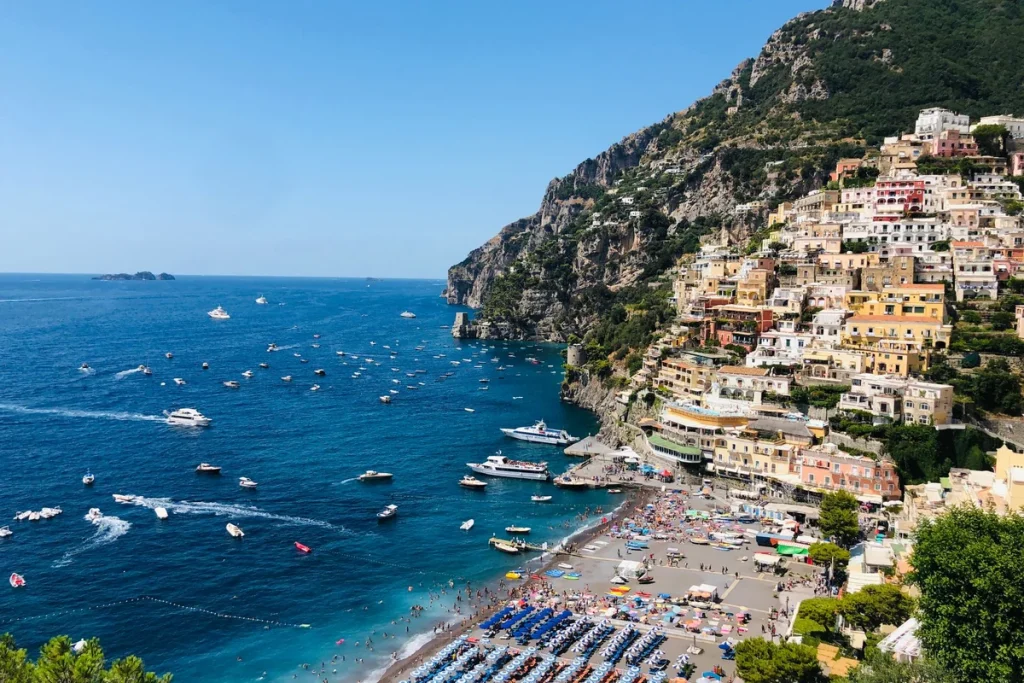
If there is one day trip to cross a country for, it is this one. The Amalfi Coast is Italy at its most cinematic: pastel villages stacked up cliffs above a sea of impossible blue, lemon groves terraced into the hillsides, and a coast road that curls from one postcard to the next. Positano tumbling to its little beach, the cathedral steps of Amalfi, the gardens of Ravello high above the water. Our Amalfi Coast solo travel guide goes deeper if you decide to give the coast more than a single day.
It is far, the better part of four hours each way, so this is a long day and the one trip where a tour truly earns its place. Someone else takes the wheel on that winding coast road while you watch the sea slide by, and you spend your energy on the villages rather than the logistics. It is the kind of day that stays with you for years.
Getting there: a full-day guided Amalfi Coast day trip from Rome is by far the easiest way, with door-to-door transport along the coast. Go on a weekday outside high summer, when the coast road is at its calmest.
A Few More Easy Escapes
If you have extra days and want shorter, simpler trips, three more sit within easy reach. Castel Gandolfo, the pope’s lakeside summer palace above the blue crater of Lake Albano, is a pretty half-day by train or bus into the Castelli Romani hills. Cerveteri and Tarquinia, north of the city, hold the great painted tombs and burial mounds of the Etruscans, two UNESCO sites that are among the most atmospheric and least crowded places in the region. And Lake Bracciano, with its medieval castle reflected in the water, makes a calm, pretty escape from the Roman heat.
Where to Base Yourself in Rome
Every one of these trips is easier when your hotel sits near Termini or Tiburtina, or on a direct Metro line to them. If you are still choosing where to stay, our full guide to the best Rome neighborhoods for women over 50 walks through the areas we recommend and why, and for the city itself, our Rome solo travel guide covers getting around and feeling at home. If Italy beyond the capital is calling, the Italy solo travel guide maps out the whole country.
Is It Safe to Take Day Trips From Rome Alone?
Yes. Italy is a welcoming, straightforward country for a solo female traveler over 50, and day trips are some of the easiest travel you can do. The trains are busy with ordinary travelers, the towns on this list see visitors year-round, and nothing here asks anything unusual of you.
A few simple habits make the day smoother. Book your return high-speed train before you leave so you are not improvising at the end of a long afternoon, and screenshot the times in case your signal drops. Keep your bag zipped and in front of you on crowded trains and in busy stations, as you would anywhere, and be aware of the usual pickpocketing around Termini and the big sights. Carry a little cash for small-town cafés and local buses that may not take cards. And validate your regional train ticket in the green machines on the platform before you board, since regional tickets must be stamped.
Staying connected is worth sorting before you travel. A travel eSIM gives you maps, train updates, and translation the moment you land, with no roaming bills and no hunting for a SIM card. For peace of mind on the longer trips, travel insurance through VisitorsCoverage means a missed connection or a cancelled tour is an inconvenience rather than a loss.
Frequently Asked Questions About Day Trips From Rome
What is the best day trip from Rome?
For first-time visitors, Pompeii is the one most people dream of, an entire Roman city you can walk through, though it makes a long day. If you want the easiest, most rewarding day with the least travel, Ostia Antica gives you the same ancient-city experience barely half an hour from the center. For sheer beauty, the Amalfi Coast is unmatched if you do not mind the distance.
Can you do Pompeii as a day trip from Rome?
Yes, comfortably. The high-speed train reaches Naples in about an hour and ten minutes, with a regional connection on to Pompeii, so you can see the site and be back in Rome by evening. A guided tour that includes the trains and entry makes the long day far simpler.
Do I need a guided tour, or can I take the train?
It depends on the distance. Ostia Antica, Tivoli, Orvieto, Florence, and Assisi are easy, pleasant train trips you can lead yourself. Pompeii with Naples and the Amalfi Coast are longer and more involved, so a guided tour that handles the transport and entries is the better choice there.
How far ahead should I book?
Reserve high-speed trains to Florence and Naples as early as you can, since fares rise as the train fills. Book timed entry for the Uffizi, the Accademia, and Pompeii a few days ahead in high season. Guided tours to the Amalfi Coast and Pompeii can sell out in summer, so a week or two ahead is wise.
When is the best time of year for day trips from Rome?
Late spring and early autumn are ideal: the countryside is at its best, the days are long, and the summer heat and crowds have eased. The gardens of Tivoli are loveliest in those cooler months, and the Amalfi Coast is far more pleasant outside high summer. The ancient sites and galleries are rewarding year-round.
You do not have to choose Rome or the rest of Italy. From a comfortable base in the city, the whole country opens up a train ride at a time, and for a solo female traveler over 50, some of your best memories may come from the mornings you spent leaving it.
When you are ready to plan it, and to swap notes with other women 50+ who love exploring Italy as much as you do, come inside the Wandersister Circle, our private space for independent women who travel solo. It is free to step inside, whether you come for the travel knowledge, the conversation, or the possibility of connecting with women who see the world much as you do.