
Tokyo announces itself immediately — neon, motion, the sensory rush of one of the largest cities on earth. Kyoto does the opposite. It reveals itself slowly, through a gate half-hidden down a stone lane, through the particular quiet of a temple garden at eight in the morning before the crowds arrive, through the sound of a wooden geta sandal on a backstreet in Gion. Kyoto solo travel rewards attention rather than stamina — and for the woman who has already imagined Japan, or who wants a first encounter with the country, it is very often the more resonant half of the journey.
For over a thousand years, Kyoto was the imperial capital of Japan, and that history is not preserved behind glass — it is lived in, walked through, woven into the daily rhythm of a city that still holds more than a thousand temples, seventeen UNESCO World Heritage sites, and entire districts of wooden machiya townhouses that look much as they did centuries ago. For a solo woman traveler over fifty, it offers something increasingly rare: genuine cultural depth, exceptional safety, and a pace that rewards the traveler who has learned that seeing less, more fully, is the greater luxury.
Why Kyoto Works So Well for Solo Women
Kyoto shares Japan’s foundational advantage: it is one of the safest places in the world for a woman to travel alone. Violent crime is exceptionally rare, street harassment is close to nonexistent, and the cultural emphasis on order and courtesy means a woman moving through the city on her own is met with quiet respect rather than curiosity or concern. A solo dinner at a counter, a late walk back to your accommodation, a train taken alone after dark — none of these carry the low background vigilance that so much solo travel elsewhere requires.
The city is also more manageable in scale than Tokyo. Kyoto is walkable in a way its larger counterpart is not, with many of its most significant sites clustered within distinct, explorable neighborhoods. Its bus and subway network is straightforward, and the flat central city is genuinely bikeable for those who prefer to explore on two wheels. This combination — profound cultural richness in a compact, navigable footprint — makes Kyoto especially well suited to a traveler who wants depth without the physical toll of a sprawling metropolis.
Where to Stay: Neighborhoods Worth Knowing
Where you base yourself shapes the entire texture of a Kyoto visit. Higashiyama, the eastern district at the foot of the mountains, places you within walking distance of some of the city’s most beautiful temples and best-preserved historic streets — an ideal choice for a first visit, offering atmosphere and proximity in equal measure. Gion, Kyoto’s famous geisha district, offers wooden teahouses, lantern-lit lanes, and a genuine sense of stepping into an older Japan, though its central streets grow busy by day.
For a quieter, more residential base, the area around the Kamo River in central Kyoto offers easy access to everything while retaining a genuine neighborhood feel, with excellent cafés and restaurants lining the water. For those seeking real tranquility, staying in Arashiyama, on the western edge of the city, means waking to bamboo groves and temple bells, at the cost of a slightly longer commute to the central sights.
Wandersister Tip
Consider spending at least one night in a traditional ryokan, a Japanese inn, ideally one with its own onsen bath. The experience of a kaiseki dinner served in your room, sleeping on a futon laid over tatami mats, and bathing in naturally heated water is not a novelty add-on to a Kyoto trip — for many women, it becomes the single most memorable night of the entire journey.
A few stays we love, from ryokan tradition to modern calm: the historic ryokan Hiiragiya, The Ritz-Carlton Kyoto by the river, and the boutique machiya Sowaka.
The Temples and Gardens That Reward an Early Start
Kyoto’s temples are its glory, and the difference between experiencing them well and experiencing them poorly comes down almost entirely to timing. Kiyomizu-dera, the great wooden temple perched on the hillside above Higashiyama, is breathtaking at opening time and merely crowded by mid-morning. Fushimi Inari Taisha, with its famous tunnels of vermilion torii gates winding up the mountainside, transforms completely depending on the hour — arrive at dawn and the first stretch of gates is yours almost alone; arrive at noon and it is a slow procession.
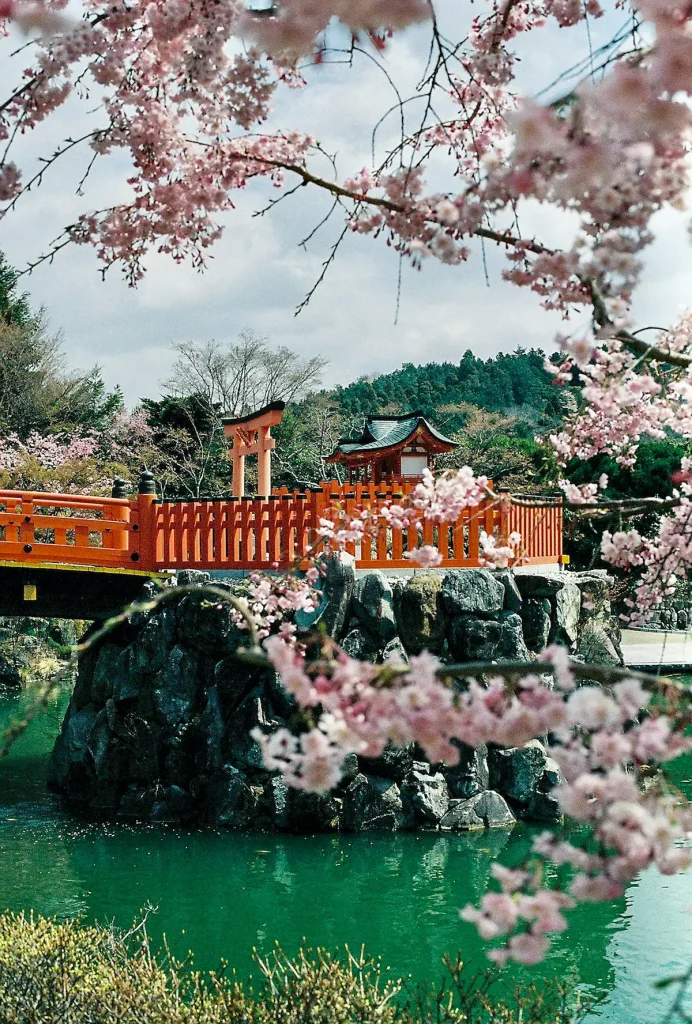
Arashiyama’s bamboo grove deserves the same early strategy, its towering green corridors most magical in the soft light and relative quiet of early morning. And the Philosopher’s Path, a stone walkway following a canal lined with cherry trees between Ginkaku-ji and Nanzen-ji, offers one of the loveliest slow walks in the city, particularly in the softer shoulder seasons when the crowds thin. Nearby, the Heian Shrine, with its striking vermilion gate and a garden framed by a covered wooden bridge, is especially beautiful in cherry blossom season, and considerably less crowded than Kyoto’s most famous sites.
Wandersister Tip
Build your days around a single anchor temple visited early, rather than attempting to see six in a single exhausting sweep. Kyoto rewards the traveler who arrives at one significant place before the crowds and lingers, over the one who rushes through many. This is the Wandersister approach to travel made almost literal — depth over checklist, presence over pace.
To enjoy the sights at their most peaceful, a morning temples and bamboo walk with a guide beats the crowds to the essentials.
Beyond the Temples: Kyoto’s Living Culture
Kyoto is not a museum, and its finest experiences are often the living ones. The city is the historic heart of the Japanese tea ceremony, and participating in one — widely available through small studios offering sessions in English — offers genuine insight into an art form built entirely around attention, ritual, and the beauty of a single unhurried hour. It is also a naturally solo-friendly activity, conducted with quiet individual care regardless of group size.
Kyoto’s food culture rewards the solo diner particularly well. Nishiki Market, a narrow covered arcade known as “Kyoto’s Kitchen,” offers an unhurried morning of sampling pickles, sweets, tofu, and seasonal specialties from generations-old stalls. In the evening, the city’s countless small counter restaurants — many seating only a handful of guests — make solo dining not just comfortable but genuinely warm, with the chef often just across the counter.
For a deeper thread of the city’s craft tradition, Kyoto’s artisan workshops — indigo dyeing, ceramics, incense, washi paper — offer hands-on half-day experiences that connect a visitor to the centuries of craftsmanship still practiced here, and make for a meaningful, memorable solo afternoon.
For a quieter afternoon, a private tea ceremony is a lovely way to slow the day down.
A Day Trip Worth Taking
For travelers with time, Nara, less than an hour away by train, makes an exceptional day trip. Home to a great bronze Buddha housed in one of the largest wooden buildings in the world, and to a vast park where tame deer roam freely among ancient temples, Nara offers a gentler, greener counterpoint to Kyoto’s density — easily managed independently, with no complicated planning required.
When to Visit
Kyoto’s two most celebrated seasons are spring, for the cherry blossoms of late March and early April, and autumn, for the extraordinary foliage of November — both genuinely spectacular, and both correspondingly crowded and expensive. For a traveler who values a quieter, more contemplative experience over peak-season spectacle, early summer and late autumn’s edges offer beautiful weather and thinner crowds. Winter brings a stark, peaceful beauty to the temple gardens and the occasional grace of snow on a temple roof, along with the lowest visitor numbers of the year.
Practical Notes for the Solo Traveler
Kyoto is served by excellent rail connections, reachable in a little over two hours from Tokyo by bullet train, and easily accessible from Osaka’s international airport. Within the city, a rechargeable IC card handles buses and subways seamlessly, and English signage is extensive around major sites and transit, though a translation app remains genuinely useful for menus and smaller establishments.
As throughout Japan, cash remains more commonly used than in much of Europe, particularly at smaller temples, shops, and traditional restaurants — carrying sufficient yen avoids unnecessary friction. Comfortable walking shoes matter enormously here, as Kyoto is a city best experienced on foot, across gravel temple grounds, up hillside steps, and along stone-paved historic lanes.
For those extending their journey beyond Kyoto into the wider country, the Wandersister Japan Guide offers additional destinations and practical guidance for building a fuller Japanese itinerary.
Fly into Osaka’s Kansai Airport (KIX), the gateway to Kyoto — compare fares and book your flights to Osaka well in advance.
Why Kyoto Belongs on Your List
Kyoto asks something different of a traveler than most destinations do. It does not overwhelm, and it does not perform for you. It waits, quietly, for the woman willing to rise early, walk slowly, and pay attention — and it repays that attention more generously than almost anywhere else on earth. For a solo woman over fifty, with the clarity to know that the richest travel is rarely the busiest, Kyoto offers not just a beautiful trip but a genuinely restorative one: a thousand years of accumulated grace, met entirely on her own terms, at her own unhurried pace.
Ready to plan your own Kyoto journey? Explore the Wandersister Japan Guide for more, or download the free Companion Vetting Toolkit at wandersister.com if you’re dreaming of sharing a Kyoto temple dawn with a Travel Sister.
Planning the rest of your trip? See our guides to Japan solo female travel over 50 and Tokyo solo travel over 50, and the bigger picture in solo travel for women over 50. And sort your travel insurance for women over 50 before you go.
When you’re ready to plan it — and to swap notes with other women 50+ who’ve done it or are dreaming of it — come inside the Wandersister Circle, our private space for independent women who travel solo. It’s free to step inside, and the solo female traveler over 50 will find good company waiting.