
There is a particular kind of quiet that Norway gives you, and you feel it the moment the train climbs above the treeline. The chatter falls away, the window fills with snowfields and still water, and you realize you have arrived somewhere that asks nothing of you except that you look. For a woman traveling on her own, that is a rare gift, and Norway hands it over freely.
Norway solo travel suits women over 50 beautifully, because the whole country seems built for the traveler who wants beauty without friction. The trains run on time. The people are warm in a low-key, easy way. English is spoken everywhere. And the scenery, from the deep fjords of the west to the Arctic light of the north, is the kind you remember for the rest of your life.
If you have been drawn to Iceland, or to the idea of the far north, Norway belongs on the same shortlist. Here is how to think about it, when to go, and how to shape a trip that feels like yours.
Why Norway Rewards the Traveler Over 50
Norway is a country that gives more to the woman who slows down. You do not need to rush between sights or tick off a list. The reward here is in the journey itself, the train that becomes the highlight, the ferry gliding under cliffs, the long light of a summer evening that never quite fades.
It is also one of the easiest places in the world to travel alone. Everything works. Public transit is clean and reliable, information is clear and in English, and there is a deep cultural respect for personal space that means you can be on your own without ever feeling watched or out of place. A woman dining solo, hiking solo, or riding the coastal ferry solo is completely ordinary here.
And Norway is a feast for the senses in the best weather-independent way. When the sun shines, the fjords glitter. When the clouds come down, the whole landscape turns soft and cinematic. There is no bad day to look at Norway.
Is Norway Safe for Solo Female Travelers Over 50?
Yes, and reassuringly so. Norway ranks third in the world on the 2025/26 Women, Peace and Security Index, and roughly 86 percent of Norwegian women say they feel safe walking alone at night. Crime that targets tourists is rare, and violent crime is very low by any measure.
For the solo female traveler over 50, this changes the texture of a trip. You can take an evening walk along the Bergen harbor, wait for a late train, or set out early for a trail without the low hum of calculation that other places demand. The practical risks in Norway are the ordinary ones, weather that shifts quickly and steep terrain, not personal safety.
Standard care still applies, as it does anywhere. Watch your footing on wet rocks and boardwalks, dress for a colder hour than the one you are in, and keep an eye on ferry and train times in remote areas. But the background worry that can shadow solo travel elsewhere simply lifts here, and that is a large part of what makes Norway such a restorative place to go on your own.
The Best of Norway: Fjords, Cities, and the Arctic North
Norway is long, far longer than most people expect, so the art of planning is choosing a region rather than trying to see it all.
Oslo is the natural place to begin. It is a small, walkable capital of harborside saunas, sculpture parks, and some of the finest museums in Scandinavia, and it rewards a day or two before you head for the water. The waterfront neighborhood of Aker Brygge and the headland at Bygdøy are lovely for an afternoon on foot.
Bergen is the gateway to the fjords and, for many women, the emotional heart of the trip. Its old wharf, Bryggen, is a row of leaning wooden merchant houses in ocher and rust, and the whole city sits in a bowl of seven hills you can ride a funicular to survey. It rains often and beautifully. Bring a good coat and lean into it.
The western fjords are the reason most people come. This is where the land splits into deep blue-green corridors of water walled by cliffs and threaded with waterfalls. The most celebrated stretch runs between Flåm and Gudvangen through the Nærøyfjord, a UNESCO-listed arm so narrow the peaks seem to lean in over the boat.
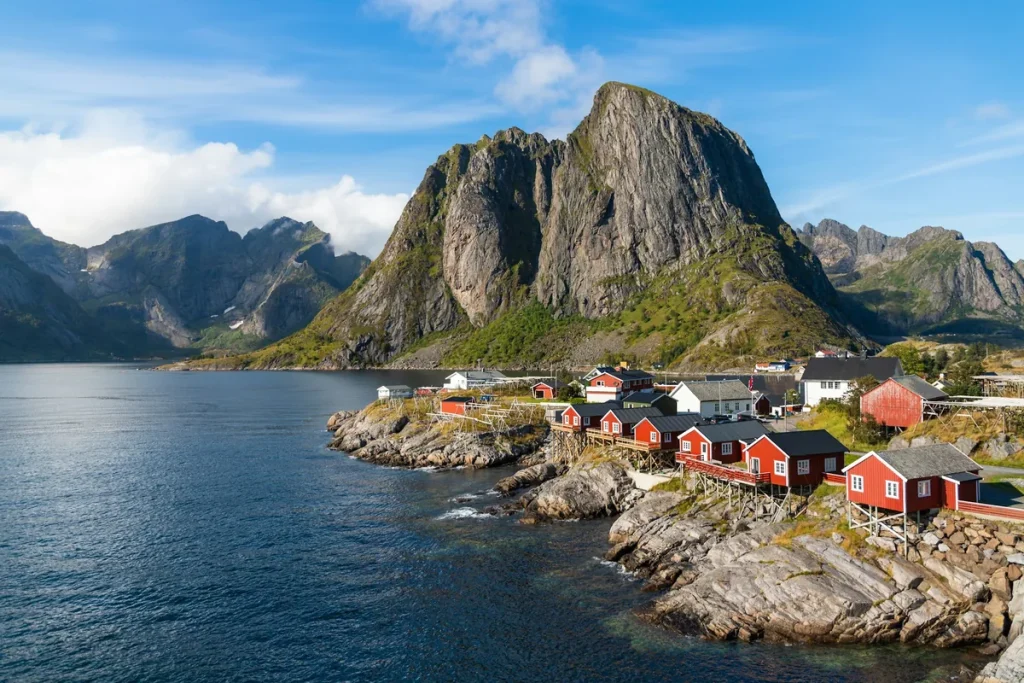
The Arctic north is a different Norway entirely. Tromsø, well above the Arctic Circle, is the easy base for the northern lights in winter and the midnight sun in summer, reachable by a short flight from Oslo or Bergen. The Lofoten Islands, with their red fishing cabins and sudden sharp mountains, are the photographer’s Norway, worth the extra effort if you have the days.
Getting Around Norway
The single best thing to know about Norway is that the transport is the sightseeing.
The Bergen Railway between Oslo and Bergen is one of the great train journeys of Europe, climbing across a high mountain plateau of snow and lakes before dropping toward the coast. From it branches the Flåm Railway, a short, steep, gasp-inducing descent past a thundering waterfall to the edge of the fjord, often named among the most beautiful rail rides in the world.
Stitch these together with a fjord cruise and you have the classic self-guided route: Oslo to Bergen by rail, down the Flåm line, a quiet electric boat through the Nærøyfjord, and on to Bergen. You can do it in one long day, but two days with a night in Flåm is far kinder and lets the scenery actually land. It is a wonderful thing to do alone, with nothing to coordinate and no one’s pace but your own.
Along the coast, the working coastal ferry has carried mail, cargo, and travelers up Norway’s shoreline for generations, and a leg of it is a beautiful, undemanding way to cover distance while the coast slides past your window. For arrivals, a pre-booked airport transfer takes the guesswork out of a first evening, whether you land in Oslo or Bergen.
Renting a car is worth it only if you want to roam the fjord back roads or Lofoten at your own rhythm; for the classic route, the trains and boats are better, greener, and far less stressful.
When to Visit Norway
Norway has two magnificent, completely different seasons, and your trip depends entirely on which one you are chasing.
Summer, roughly late May through August, is fjord season. The days stretch impossibly long, the far north basks in the midnight sun that never sets, and every boat, train, and trail is running. This is the time for the western fjords, for hiking, and for the softest weather Norway offers. It is also the busiest and priciest window, so book ahead.
Winter, roughly late September through March, is northern lights season. From Tromsø and the Arctic north, the aurora is visible on clear nights across those months, with the darkest weeks of midwinter offering the longest hunting hours. From Tromsø, a guided northern-lights chase does the driving and the cloud-dodging for you, which is exactly what you want on a cold, clear night.
There is a particular reason to go soon: the current solar maximum, the peak of the sun’s activity cycle that supercharges the lights, is winding down through 2026, so the next couple of seasons are especially promising. If chasing the aurora is your reason for coming, our guide to seeing the northern lights is worth reading before you go.
March and April are a quiet sweet spot, with returning daylight, calmer weather, and a good chance of aurora still on the table. If you want both fjords and lights, you will likely need two trips, and that is no bad thing.
Where to Stay in Norway
Norway’s hotels are comfortable, well-run, and, yes, expensive, so choose a characterful base in each stop and let it anchor your days.
In Oslo, the harbor-front Amerikalinjen, set in the old headquarters of a transatlantic shipping line, has warmth and history a short walk from the station. In Bergen, the Clarion Hotel Admiral sits right on the water with fjord-and-Bryggen views from many rooms, ideal for the woman who wants the harbor at her window. In Flåm, the classic Fretheim Hotel puts you at the very edge of the fjord for that magical overnight between trains. And in Tromsø, the Clarion Hotel The Edge is a modern, central perch for aurora nights and Arctic mornings.
Booking a hotel with breakfast included is a small kindness to your budget in Norway, where a morning meal out adds up quickly.
A Sample Norway Itinerary for Solo Travelers
Here is one relaxed way to shape a first Norway trip of about a week, built around the classic fjord route with room to breathe.
Days 1 to 2 — Oslo. Ease in. Wander the waterfront, ride the ferry to the museum peninsula, sit with a coffee and watch the harbor. Let the jet lag settle before the country opens up.
Day 3 — The Bergen Railway to Flåm. A full day of the finest train scenery in Europe, up over the roof of Norway and down the Flåm line to the fjord. Sleep in Flåm, small and quiet, with the water outside your window.
Day 4 — Fjord cruise to Bergen. A morning boat through the Nærøyfjord, the trip’s showpiece, then onward to Bergen. Arrive in time to ride the funicular up for the long evening light.
Days 5 to 6 — Bergen. Slow days among the wooden wharf houses, the fish market, and the seven hills. This is the trip’s soft landing, a real city with room to just be.
Day 7 — Onward or home. Fly out from Bergen, or, if you have added days, catch a short flight north to Tromsø for a different Norway entirely.
Add an Arctic extension of three or four nights in Tromsø whenever the lights are your reason for coming.
What Norway Costs
There is no getting around it: Norway is one of the more expensive countries in the world, and it helps to know that going in so it does not surprise you.
As a rough guide for 2026, a comfortable mid-range day, counting a nice hotel, meals, and a paid excursion or two, tends to land somewhere around 190 to 255 US dollars, with hotels averaging near 178 dollars a night for a double. You can spend far more on a private fjord cruise, and a little less by leaning on hotel breakfasts, supermarket lunches, and the transport passes.
The good news is that Norway’s greatest pleasures, the train windows, the fjord light, the harbor walks, the long northern evenings, are free. You are paying for a very high standard of ease and comfort, and for scenery that earns every krone.
Good travel insurance for women over 50 is worth arranging before any trip this far north, where weather can reshuffle ferries and flights and a canceled connection is best met with a shrug rather than a scramble.
Practical Tips for Norway Solo Travel
- Pack for four seasons in one day. Layers, a genuinely waterproof coat, and sturdy shoes matter more than anything fashionable. The weather turns fast, especially in the fjords and the north.
- Carry very little cash. Norway is nearly cashless; a tap card or phone works for everything, from the smallest ferry to the coffee cart.
- Stay connected easily. A travel eSIM loaded before you fly means maps and ferry times work the moment you land. See our guide to staying connected abroad.
- Book the marquee days ahead. Summer trains, the Flåm line, and aurora tours sell out. Reserve the fixed points and leave the rest loose.
- Eat well without overspending. Bakeries, harborside fish markets, and hotel breakfasts are your friends. And if dining alone still feels daunting, it will not for long here; see how to eat alone and enjoy a window table with a clear conscience.
Norway Solo Travel FAQ
Is Norway safe for solo female travelers?
Very. Norway is among the safest countries in the world for women, ranking third on the 2025/26 Women, Peace and Security Index, with very low crime and a strong culture of personal space. It is one of the most reassuring places a woman can travel alone.
Is Norway expensive to travel?
Yes, Norway is one of the more expensive countries to visit. A mid-range day runs roughly 190 to 255 US dollars in 2026. You can soften the cost with hotel breakfasts, supermarket lunches, and the fact that the scenery itself is free.
What is the best time to visit Norway?
Late May through August for the fjords, long days, and the midnight sun. Late September through March for the northern lights in the Arctic north. March and April are a quiet, lovely bridge between the two.
When can you see the northern lights in Norway?
From roughly late September to early April, best from Tromsø and the far north on clear, dark nights. The current solar maximum is winding down through 2026, which makes the coming seasons especially good for the aurora.
How many days do you need in Norway?
About a week covers the classic Oslo, fjords, and Bergen route at a comfortable pace. Add three or four nights for an Arctic extension to Tromsø or the Lofoten Islands.
Do people speak English in Norway?
Almost universally, and very well. You will have no trouble navigating, ordering, or asking for help anywhere in the country.
Is Norway Right for a Solo Female Traveler Over 50?
If you long for beauty, calm, and the deep ease of a place where everything simply works, Norway may be one of the most rewarding trips you ever take on your own. It asks little and gives enormously, a country of water and light where a woman traveling solo is free to move at exactly her own speed.
It pairs naturally with the other great safe northern trips, so if Norway calls to you, our guides to Iceland solo travel and the safest countries for solo female travelers are good next reading, as is our cornerstone guide to solo travel for women over 50.
When you’re ready to plan it — and to swap notes with other women 50+ who’ve done it or are dreaming of it — come inside the Wandersister Circle, our private space for independent women who travel solo. It’s free to step inside, and the solo female traveler over 50 will find good company waiting.